Friday, April 20, 2012

Japanese Internment Art - More Than Just A Creativity Outlet


            Our discussion of Japanese Internment art inspired me to look further into the topic.  I stumbled upon this NPR article about an exhibit in the Smithsonian in Washington D.C.

            The article starts by introducing Noman Mineta, a Japanese man who spent time in the internment camps as a child, that ended up serving in congress and as Commerce Secretary under President Bill Clinton.  By using him an example, Stamburg (the author) provides an example of firsthand experience from someone the reader can respect as an intellectual and public patron.  Mineta explains that they had “no furniture…all you get is four blank walls and one light bulb.”  Though this situation was dire, it provided an opportunity for great creative expression through art.

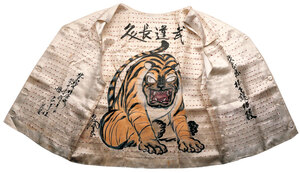
Senninbari vest, silk cloth, thread, ink, buttons, paint
            What I found most interesting about the pieces included in the article is their tremendous detail and workmanship.  The interned were forced to use “whatever materials they could find,” and yet they were still able to create fantastic pieces of art.  For example, a cream-colored vest is on display from the Amache camp in Colorado, decorated with “1000 red, French-tied knots.”  It is surprising to me that in such horrible and hopeless conditions a mother was able to create such an elaborate vest for her son.  According to the article, the vest “was passed around in the camp, and this was in order to provide strength and good luck for the person it was given to.”  In other words, art wasn’t only a way to express feelings and creativity; it also served as a way to maintain community and Japanese American culture.

            Another interesting fact is that many of the artists in the camps had never been artists before.  After entering the camps, they harnessed their artistic skills - a “wonder…[that they] could create things of beauty…in such adversity.”  And thus, a beautiful thing stemmed from oppression and horror, providing a sense of hope for generations of Japanese Americans in the years to come.

http://www.npr.org/templates/story/story.php?storyId=126557553

To Live and Die in L.A.

In brainstorming for what I wanted to talk about for this blog post, I inevitably thought of the familiar east vs. west coast rivalry. (I'm from Boston, born and raised... don't mess). So as I was thinking about this, I remembered of course, Biggie and 2pac. This lead me to 2pac's song "To Live and Die in L.A." Besides being super smooth and a great song, the lyrics speak a lot to east coast/west coast dynamics as well as internal conflict in Los Angeles.

2pac talks a lot about how there's this weird combination of pursuit of wealth and fame and the glittery stuff of LA, but at the same time is incredibly dangerous and wrought with conflict. A particularly interesting verse to me is the third one I believe:

'cause would it be LA without Mexicans?
Black love brown pride and the sets again
Pete Wilson trying to see us all broke, I'm on some bullshit
Out for everything they owe, remember K-DAY
Weekends, Crenshaw -- MLK
Automatics rang free, guess we lost our way
Gang signs being showed, brother love your hood
But recognize that its all good

2pac gets at this sort of melting-pot L.A. has that really not everywhere in the United States does. While definitely alluding to gangs and gang violence, it also comes across to me as a commentary on how to respect differences within a really diverse location without turning it into rivalry. Pete Wilson, for the record (I did a little research) was the republican governor of California from 1991-1999 (during which time this song came out). He (Wilson) was not particularly popular with a lot of people, and this song, at least, seems to name him as a force working against the unity of the city of L.A.
Crenshaw and MLK are, as far as I can tell, both boulevards in Los Angeles. What I got from this verse was as opposed to showing pride for your community, that pride has turned into hostility towards others, which has made those streets not safe spaces to be anymore.

So, in short, its complicated. The aspects of diverse and interacting communities is exactly what makes Los Angeles wonderful and what it is, but also might be what tears it apart.

Also, this is incredibly pertinent, 2pac appeared IN HOLOGRAM FORM AT COACHELLA. I know, it is insane.

Tapscott and L.A. Local Jamming!


Throughout the section on LA I kept going back to the response book I’d read, Black Arts West by Daniel Widener. While reading the book I learned about local musician, Horace Tapscott. Tapscott was highly involved with his community, he played his music with and for them. The style that was created was in a way “birthed” by the local, but it would later be categorized as free jazz. Leaving that part behind, I think this style of music is awesome to learn about. Sometimes it’s choppy and yes, sometimes it sounds a little strange but I think if you take a step back and realize how much feeling the music has it can be really incredible. Since everything is so improv, the artists’ conditions and the music are inexorably linked, the music is, kind of literally, played with feeling.
I began listening to some recordings, but to fully understand I think it’s better to SEE it being playing (of course there isn’t really an electronic means to replace actually being there) but anyways…the important thing to remember while I go off on tangent is that the music was a community thing


Here's an article about him and his work in the community! -
Click me!!! LA times article on Tapscott
andddd here's a clip of music being played Link to Jam sesh

Improvisational music has always made me wonder.. sometimes I love it and sometimes I'm just a little lost. But then there are those really awesome combinations of people that get together and it's a little awe-striking, thinking about how crazy creative they must be to come in and feel it, just improvise, and inspire and freestyle off one another. A lot of people aren’t too fond of this style; and though odd time signatures, syncopation, and clashing rhythms can sounds a little strange, it can also be like pure awesomeness (clip 4:35 - 4:42 AH!)  All the moments leading to those few seconds have to be there. There have to be some ups and downs, ins and outs, wrongs and rights, evens and odds, for the music to have an impact. It's kind of like Killer of Sheep, life isn't always high rolling and good times, a lot of it is choppy and most of the time people are just trying to make their way through...so basically I think that we might forget or aren’t exposed to the fact that in our own minds, in life, things rarely work out beautifully and in rhythm. This kind of improvisational jazz is about collectively working on expression, and for many that is simultaneously a way to reflect and ‘work’ on life. This can be a beautiful thing in its own right and it is truly powerful.

 From the article!: Tapscott's band was playing. "Somebody told him there was a young guy in the audience with some poetry. Next thing I knew I was performing onstage with them. That's the kind of thing he would do. . . . That simple act opened up my life tremendously."
(the interviewee Michael says this music kept him going, and think back to the cinema production about Treme, where the entire city was influenced/centered around music in the community)


This improvisational style is not only meant to be heard, it's meant to be used and shared,  as Horace’s mentor noted  "I'll teach you...if you promise to pass it on."I think that's such a powerful message and it really makes me wonder about the character of these musicians and the communities that inspired them.  Here's another clip about Tapscott from the paper article - "With his talent, they said, he could have hit worldly heights. Instead he stayed and made "community artist" a noble profession. He played at community events, prisons, schools, on the Black Panthers' albums of the early '70s--and lost work because of his activism. He created the Union of God's Musicians and Artists Ascension, an organization that brought together, musicians, poets and other artists. Art is contributive, he would say, not competitive." 
(this also makes me think about our discussion about the art made at Manzanar. Both challenge, albiet in different ways, what art is, what its purpose serves, and who it is for etc. )
The most well known organization Tapscott helped found was the Pan Afrikan People's Arkestra, which continues to train and play the less well known work of local and global African American artists today. They also incorporate poetry, dancing and singing. These arkestra's  kind of remind me of the colonias we read about in the first section on Padua Hills, the arkestra gatherings served as little "hub spots" all over, bringing the global to each local and vise versa.  Tapscott was involved in his community till the end, and his music came from and was for all. Sharing music was a way to affirm and construct both self and group identity.


-"This is where I learned how to say, 'I love you' . The Ark taught the spiritual aspects of your being and everyone else's. We all learned to love life, the music, the spirit and each other."


The Camps According to Dorothea Lange


After reading Kristine Kuramitsu’s article I wanted to find out more about historical records from the Japanese-American interment camps, which led me to a 2006 New York Times article The War Relocation Association closely monitored the photographs and films that documented life in the interment camps, but in 2006 a series of photographs by Dorothea Lange were uncovered in the National Archives.  While she may be best known for her documentary style photographs of the Great Depression, these 800 photos captures the emotions and lives of the internees. 
Originally hired by the WPA to document life in the camps, Langue chose to document the truth rather than to portray a happy, normal living environment that did not violate international laws or mistreat the occupants.  The government ultimately confiscated her photos and kept them buried for over fifty years.  Her photos stand in stark contrast to Ansel Adams’s photos of life in the camp at Manzanar, California that showed heroic poses and used the beautiful Sierra Mountains as a background.  The WPA consistently restricted Lange’s access to the camps, refusing to allow her to photograph wire fences, watchtowers with searchlights, armed guides, or any signs of internees resisting.  They discouraged her from talking to the very people she was hired to photograph.  Langue unflinchingly photographed hospital patients in beds outside next to the latrines, schoolchildren sitting on the floor because there were no desks or chairs, and horse stalls that housed families.  Lange also chose to emphasize the Americanness of the internees, showing a young boy reading a comic book, a boy in a baseball hat, and a United States army volunteer helping his family move in to a camp.  I began googling Dorothea Langue images and couldn’t stop.  It’s really striking to see the snapshots of life in the camps that she managed to capture. 100 of her images were published for the first time in the 2006 book, Impounded: Dorothea Lange and the Censored Images of Japanese American Interment.   

Dorothea Lang and the Japanese Internment Camps


         Dorothea Lange was an American documentary photographer and photojournalist. She is best known for her documentation of migrant workers and farm families during the Great Depression. Because of this work, she was chosen by the United States government to document life in the Japanese internment camps. Even though she had seen displacement and poverty during the depression, she was not prepared for the alarming racism and blatant civil rights abuses she saw in the camps. She later commented, “What was horrifying was to do this thing completely on the basis of what blood may be coursing through a person’s veins, nothing else. Nothing to do with your afflictions or friendships or associations. Just blood.”
        Lange’s photos of the camps are extremely important because she documented aspects of the camp that were hidden from the public for many years.  These images provide some of the only examples of what life was really like in the camps. In 2006, 800 new images of the camps, which were confiscated by the U.S. government about 50 years ago, were released to the public. These images showed the inhumane conditions that the internees had to suffer through. People were forced to live in “horse stalls and tar-paper shacks where they endured brutal heat and bitter cold, filth, dust and open sewers.”
       The photos were alarming, not only because they exposed the atrocities committed by the United States government, but also because of their relevance to current events. Japanese people were interned during the war because of fear; they posed no threat to national security. According to Gary Y. Okihiro, the author of a book on the internment camps, “there are some disturbing parallels between the treatment of Japanese Americans in 1942 and that of Muslins and other American citizens since the attacks of 9/11.” These images should cause people to question the xenophobia that seems to characterize American society and the effect that this unprovoked discrimination can have on people’s lives. 

http://www.nytimes.com/2006/11/06/arts/design/06lang.html?_r=2 (This article contains a lot of Lange's pictures)

Watts: Beauty and Tumult

Thinking back on what we have covered for the Los Angeles portion of the class, out of the readings and movie, it was Killer of Sheep that had the most impact for me.  While at first I was trying to make sense of the movie as I watched it unfold, it was upon our reflection in class that it all came together.  Though the film was rather random, it was a succinct portrayal of life.  As I thought about Stan and what his life was like, my thoughts began to move towards the city of Watts.  What more is there to Watts?   

Two major things come up when you look up Watts on the internet; the August 1965 riots and the Watts Towers.  The Watts Towers are what I find to be quite intriguing.  Built between 1921 and 1955 by Italian immigrant Sam Rodia, the Towers are a wonderful piece of folk art situated in a city that most have forsaken.  There is a documentary, "The Towers", that brought together for me many parallels between the the Watts of Sam Roida in the mid-50's and that of Stan in Killer of Sheep circa the early 70's.  

The railroad tracks are an important aspect of both temporal periods.  They are place for the children to play in Killer of Sheep while for Sam Rodia they also play an important aspect in his life.  The railroad tracks are place he wanders to find discarded pieces of glass, pottery, metal and other items.  He also uses the tracks as a tool to bend the metal for his towers.  Unlike Stan who has been beaten down by life, Sam Rodia embraces life and spends all his free time working on his creation.  Poverty is prevalent in both 1950's and 1970's Watts but there is living going on in spite of this.  It's a matter of how people deal with their lives and what they actually make of it.

Because of their location, the Watts Towers are generally not a top destination for people in the greater L.A. basin.  Part of it is based on lingering notions that Watts is not safe even though the riots occurred  almost 47 years ago.  The other aspect for people not visiting is that it is not near other area attractions.  In spite of all this, the Towers remain an important landmark reflecting the human spirit and how it prevails even under harsh economic conditions.


Constructing History


(The videos might be a little long for such a busy time of the semester, so I put the times of the clips that I thought were most important to watch next to the links)

Our reading and discussion of Kristine Kuramitsu’s article “Internment and Identity in Japanese American Art” brought to surface the importance of examining this event through various artworks, so I decided to examine some of these sources and investigate how they not only construct history on their own, but also create a more refined history in the way that they speak to one another.

Of the works that came out from Japanese internment, nothing seems more “carefully constructed” than the films of the WRA (3:14-7:25…8:35-end) that conveyed an “exaggerated normalcy” of the camps to the U.S. public (Kuramitsu 423). It strikes me that the narrator portrays the Japanese Americans as whole-heartedly accepting their situation, and opens and closes by arguing that the United States should be seen as a model country in treating even potential enemies with care.  Viewers see the camps as an opportunity for the Japanese to “reclaim the desert” with the support of helpful government officials. 

A more ambiguous image of internment is created when we consider this documentation next to Never Again—A Story of Yaeko Nakano, a short film that relays a first hand experience of Japanese Internment. While Nakano was able to explore music in prison similar to the artists in Kuramitsu’s chapter, she also emphasizes the hardships that came with leaving.  The WRA video mentions the shops these people left behind, but omits the manner in which families were broken and uprooted from homes.  Nakano reveals the complex feelings that came with internment, as she was sad to leave Tacoma but was “looking forward to her trip”, and went on to discover love and music in the camp.

The history of Japanese Internment is further constructed by the art of third-generation Japanese Americans, such as the poem “Letters from Tule Lake Internment Camp” by David Mura.
(2:22-End) The “healthful nourishing food” described by the WRA is here described as “putrid gray beans”, and the music described in the opening can be compared to the Nakano’s piano playing.  His introduction connects Japanese treatment in the 1940s to Muslim-Americans after 9/11, showing the manner in which perceptions of history are also understood in terms of the present context and issues. 
            
The WRA films, various works from the prisoners, and art created by descendants of the prisoners help us understand how Japanese Internment was perceived, and is perceived today. That is, these sources prove that history truly is a “construction” that is “never-ending” (Kuramitsu 619).