Friday, April 20, 2012

Why Internment?


Because I didn't learn much about Japanese Internment in high school, I decided to research it more. Once I understood the whole debacle, the main question I was left with was, why were the Japanese interned in the first place?
I know that the internment was a response to Pearl Harbor. Although I knew that Japanese Internment was a huge racism issue, I had always thought that it stemmed from a strictly political background. I had assumed that it was meant as a way to prevent Japanese spies or terrorists to be living among other Americans or let them go unaccounted for. However, the more I researched this, the more vague the answers I get come across, and very few mention a fear of spy’s or terrorists. No foul play ever occurred from any Japanese-American, and there was really no reason to do it. It seems that, when it comes down to it, the only answer that makes logical sense is that the interment was based solely on racial prejudice. It was an excuse to separate the Japanese from the rest of the US.

For example, Lieutenant General John L. DeWitt, head of the Western Command and an administrator in an internment camp, testified to congress that
“I don't want any of them [persons of Japanese ancestry] here. They are a dangerous element. There is no way to determine their loyalty... It makes no difference whether he is an American citizen, he is still a Japanese. American citizenship does not necessarily determine loyalty... But we must worry about the Japanese all the time until he is wiped off the map”

These Japanese people were American, and living in America, and had shown no signs of causing danger, so it really would make no sense that they would or possibly could do anything to harm the American people.

However, a legitimate argument could easily be made that Pearl Harbor caused a fear of the Japanese and whose “side” they were on. Aside from keeping people at bay, the interment kept any potential Japanese terrorists away. In the end, the whole point of the Japanese Internment is ambiguous, but it seems like a safe bet to assume that is was ultimately a way to exclude a race.

Japan in the U.S.


When writing my review of a cultural activity in L.A. on the Japanese American Cultural Museum, I felt a little frustrated because I felt I wasn’t telling the important part of the story. What stuck with me and bothered me was the in between stuff.

Little Tokyo's Kinokuiya

First of all, I love bookstores, and since I was in Little Tokyo, Kinokuniya was an absolute must. After the Japanese American Cultural Museum closed, I headed over. Throughout, I was in analytical American-Studies mode, and in particular, I was acutely interested in examining which elements of a Japan-themed bookstore were authentically Japanese, and which were meant to appeal to a Western clientele. Was the merchandise equivalent to what you would find at a real Japanese store? How much of the merchandise was meant for customers with a genuine interest in Japanese culture, and how much of it panders to a new Orientalism? Were we like the visitors of the Padua Hills Theatre, participants in an imagined, fake history for Japan?

Certainly, in the section of books in English, I found many about courtesans and samurais from ages ago. I was especially suspicious of names that sound exceedingly white on the covers of historical fiction. It reminded me of Arthur Golden who wrote “Memoirs of a Geisha.” This whole genre of books from Japan’s exotic past strikes me as possibly misleading, perhaps exaggerated, and fixated on the differences between Japanese and American experience rather than its universality. A quick search on Wikipedia demonstrated something similar: the main interviewee Golden used to write his novel later sued him and wrote her own version of geisha life. On the other hand, Japanese interest, from what I gathered, at least in samurais, might be as great as American interest. Many of their classics are about feudal lords, and many Japanese-name histories of samurais were on the shelves. Still, I feel Japanese American interest arises from inquiry into their personal heritage, while Western interest simply seeks to gawk.


Many of the publishers of the more sophisticated literature, and definitely of the histories, were universities: Duke, Columbia, Yale…if I remember correctly. (The other publishers, with the exception of Puffin and Vintage International, I had never heard of before, so I assumed that they were independent.) This, to me, was significant in that not much literature is available from Japan. Colleges are currently in the processes of expanding the translated availability in the U.S. Also, since almost no big book sellers were represented, Japanese literature in general must not be considered very marketable. What was most interesting was that any book about early immigrants from Japan was invariably published by the University of Hawaii. As I found in the Japanese American museum, Hawaii was guilty of a plantation system somewhere between slavery in the South and the one described by Matt Garcia. Its investment in recording that past is commendable.

(University of Hawaii Press, books about Japan: http://www.uhpress.hawaii.edu/c-22-japan.aspx)

Finally, the two bookshelves on Japanese literature and culture merged abruptly into a section on Asian literature in general. This I found very indicative of the way all Asian cultures get clumped together, even in a Japanese bookstore. The marketing assumption is that readers are looking for something Oriental and it doesn’t matter what sort of specific Orientalism it is. In fact, I gravitated toward a novel about an immigrant from Korea, but I would’ve felt guilty placing that single book in front of the very Japanese bookstore clerks.

(I ran out of room and my post is too long again (L), but I took the Metrolink train on the way there and back, and I became painfully aware of the difference between my socioeconomic status and that of the crowd around me. I could’ve spent the whole post talking about what some strangers said to me, but I started out with the bookstore first and there you have it...)

Nisei soldiers

Coincidently, our discussing of Japanese internment has coincided with a reading I did for my Women in US History course here at Scripps. The book was Nisei Daughter by Monica Sone, and it's about the author's experience growing up as a first generation Japanese women in Seattle; including her experience during World War II and internment. Not only did I find a connection between the general themes and context of this book with the material we have looked at, but there have also been smaller details in the book that connect with our readings. For one, there is the idea of young Japanese- American men fighting for the US. In our discussion yesterday on the two short stories by Hisaye Yamamoto, Professor Delmont mentioned that the author had a brother who died fighting for the US army in Italy. Interestingly, in Sone's autobiography, her brother is recruited into the army while her family is living in an internment camp. However, in the book, it is clear that this "recruitment" is not voluntary. Sone describes the experience as officers entering the camps and giving the young men the option of enlisting, but that if they didn't it would be proof of their loyalties to Japan. Because of this, many young men felt as if they had either no choice, or (in the case of Sone's brother) they wanted to prove their patriotism.  As Sone's brother is overseas fighting, his family remains locked up in an internment camp. To me, this further proves how outrageous this exclusion really was. For the US government to allow these men to risk their lives, and end others' for our country, and yet their parents remain trapped - their homes and possessions acquired by the state- is mind-blowing. 


Although Nisei men were welcome into the army, they were separated into their own combat unit called the 44nd Regimental Combat Team. Ironically, they were the most highly decorated regiment in the history of the United States armed forces. 486 Purple Hearts, among hundreds of other awards. 

Cue the educational video. 

California Nisei College Diploma Project

Starting in 2009, California public universities began retroactively awarding diplomas to Japanese American students that were interned. This initiative, called the California Nisei College Diploma Project, has awarded diplomas to over 1,000 displaced Nisei, all of whom were U.S. citizens. However, the Project only affects those who studied at public universities in California, neglecting the many Japanese Americans who went to private schools.

According to this article, however, USC has recently become the first private college in California to award diplomas to displaced students. Though some people may be upset that USC and other California colleges are bothering themselves with business that began seventy years ago, these diplomas are more than empty symbols to the Japanese American community. One of the people behind this legislation has said, "A lot of people didn't even know their relatives had gone to college," and never went after they were released from internment.

This speaks to the silence that surrounded internment in the years following WWII. As the Kuramitsu article pointed out, in the 1960s and 70s, many Sansei were shocked to find that Japanese American internment had occurred at all. Internment was considered a shameful time in the Japanese American community and many older people did not talk about their experiences. By trying to move on and assimilate into mainstream American culture, many Nisei went along with government aims to sanitize the camps. The fact that the WRA tried, and often succeeded, in portraying the camps as centers of "normal" community activity is shocking, as the underlying cause for these communities should never be seen as a normal aspect of life. Yet, because the Korematsu decision remains as legal precedent, the normalcy of geographic exclusion is enshrined in the US government.

The reason I'm so interested in this legislation is because it hits close to home for me. This past fall, two of my great aunts were awarded their diplomas from Compton Junior College. (At about the 6:59 mark you can see both of them graduate!) I don't know if they ever went back to school after the war, but I do know they weren't even in the camps that long. They volunteered to go to Detroit to work in factories and help with the war effort. I guess this is something I just don't understand about the shame and silence that surrounded internment. Hundreds of Japanese Americans showed a loyalty and patriotism towards a country that was ambivalent, at best, towards them. I certainly see things to be ashamed of, but nothing that can fall on the shoulders of Japanese Americans.

Japanese Internment Art - More Than Just A Creativity Outlet


            Our discussion of Japanese Internment art inspired me to look further into the topic.  I stumbled upon this NPR article about an exhibit in the Smithsonian in Washington D.C.

            The article starts by introducing Noman Mineta, a Japanese man who spent time in the internment camps as a child, that ended up serving in congress and as Commerce Secretary under President Bill Clinton.  By using him an example, Stamburg (the author) provides an example of firsthand experience from someone the reader can respect as an intellectual and public patron.  Mineta explains that they had “no furniture…all you get is four blank walls and one light bulb.”  Though this situation was dire, it provided an opportunity for great creative expression through art.

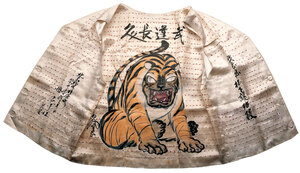
Senninbari vest, silk cloth, thread, ink, buttons, paint
            What I found most interesting about the pieces included in the article is their tremendous detail and workmanship.  The interned were forced to use “whatever materials they could find,” and yet they were still able to create fantastic pieces of art.  For example, a cream-colored vest is on display from the Amache camp in Colorado, decorated with “1000 red, French-tied knots.”  It is surprising to me that in such horrible and hopeless conditions a mother was able to create such an elaborate vest for her son.  According to the article, the vest “was passed around in the camp, and this was in order to provide strength and good luck for the person it was given to.”  In other words, art wasn’t only a way to express feelings and creativity; it also served as a way to maintain community and Japanese American culture.

            Another interesting fact is that many of the artists in the camps had never been artists before.  After entering the camps, they harnessed their artistic skills - a “wonder…[that they] could create things of beauty…in such adversity.”  And thus, a beautiful thing stemmed from oppression and horror, providing a sense of hope for generations of Japanese Americans in the years to come.

http://www.npr.org/templates/story/story.php?storyId=126557553

To Live and Die in L.A.

In brainstorming for what I wanted to talk about for this blog post, I inevitably thought of the familiar east vs. west coast rivalry. (I'm from Boston, born and raised... don't mess). So as I was thinking about this, I remembered of course, Biggie and 2pac. This lead me to 2pac's song "To Live and Die in L.A." Besides being super smooth and a great song, the lyrics speak a lot to east coast/west coast dynamics as well as internal conflict in Los Angeles.

2pac talks a lot about how there's this weird combination of pursuit of wealth and fame and the glittery stuff of LA, but at the same time is incredibly dangerous and wrought with conflict. A particularly interesting verse to me is the third one I believe:

'cause would it be LA without Mexicans?
Black love brown pride and the sets again
Pete Wilson trying to see us all broke, I'm on some bullshit
Out for everything they owe, remember K-DAY
Weekends, Crenshaw -- MLK
Automatics rang free, guess we lost our way
Gang signs being showed, brother love your hood
But recognize that its all good

2pac gets at this sort of melting-pot L.A. has that really not everywhere in the United States does. While definitely alluding to gangs and gang violence, it also comes across to me as a commentary on how to respect differences within a really diverse location without turning it into rivalry. Pete Wilson, for the record (I did a little research) was the republican governor of California from 1991-1999 (during which time this song came out). He (Wilson) was not particularly popular with a lot of people, and this song, at least, seems to name him as a force working against the unity of the city of L.A.
Crenshaw and MLK are, as far as I can tell, both boulevards in Los Angeles. What I got from this verse was as opposed to showing pride for your community, that pride has turned into hostility towards others, which has made those streets not safe spaces to be anymore.

So, in short, its complicated. The aspects of diverse and interacting communities is exactly what makes Los Angeles wonderful and what it is, but also might be what tears it apart.

Also, this is incredibly pertinent, 2pac appeared IN HOLOGRAM FORM AT COACHELLA. I know, it is insane.

Tapscott and L.A. Local Jamming!


Throughout the section on LA I kept going back to the response book I’d read, Black Arts West by Daniel Widener. While reading the book I learned about local musician, Horace Tapscott. Tapscott was highly involved with his community, he played his music with and for them. The style that was created was in a way “birthed” by the local, but it would later be categorized as free jazz. Leaving that part behind, I think this style of music is awesome to learn about. Sometimes it’s choppy and yes, sometimes it sounds a little strange but I think if you take a step back and realize how much feeling the music has it can be really incredible. Since everything is so improv, the artists’ conditions and the music are inexorably linked, the music is, kind of literally, played with feeling.
I began listening to some recordings, but to fully understand I think it’s better to SEE it being playing (of course there isn’t really an electronic means to replace actually being there) but anyways…the important thing to remember while I go off on tangent is that the music was a community thing


Here's an article about him and his work in the community! -
Click me!!! LA times article on Tapscott
andddd here's a clip of music being played Link to Jam sesh

Improvisational music has always made me wonder.. sometimes I love it and sometimes I'm just a little lost. But then there are those really awesome combinations of people that get together and it's a little awe-striking, thinking about how crazy creative they must be to come in and feel it, just improvise, and inspire and freestyle off one another. A lot of people aren’t too fond of this style; and though odd time signatures, syncopation, and clashing rhythms can sounds a little strange, it can also be like pure awesomeness (clip 4:35 - 4:42 AH!)  All the moments leading to those few seconds have to be there. There have to be some ups and downs, ins and outs, wrongs and rights, evens and odds, for the music to have an impact. It's kind of like Killer of Sheep, life isn't always high rolling and good times, a lot of it is choppy and most of the time people are just trying to make their way through...so basically I think that we might forget or aren’t exposed to the fact that in our own minds, in life, things rarely work out beautifully and in rhythm. This kind of improvisational jazz is about collectively working on expression, and for many that is simultaneously a way to reflect and ‘work’ on life. This can be a beautiful thing in its own right and it is truly powerful.

 From the article!: Tapscott's band was playing. "Somebody told him there was a young guy in the audience with some poetry. Next thing I knew I was performing onstage with them. That's the kind of thing he would do. . . . That simple act opened up my life tremendously."
(the interviewee Michael says this music kept him going, and think back to the cinema production about Treme, where the entire city was influenced/centered around music in the community)


This improvisational style is not only meant to be heard, it's meant to be used and shared,  as Horace’s mentor noted  "I'll teach you...if you promise to pass it on."I think that's such a powerful message and it really makes me wonder about the character of these musicians and the communities that inspired them.  Here's another clip about Tapscott from the paper article - "With his talent, they said, he could have hit worldly heights. Instead he stayed and made "community artist" a noble profession. He played at community events, prisons, schools, on the Black Panthers' albums of the early '70s--and lost work because of his activism. He created the Union of God's Musicians and Artists Ascension, an organization that brought together, musicians, poets and other artists. Art is contributive, he would say, not competitive." 
(this also makes me think about our discussion about the art made at Manzanar. Both challenge, albiet in different ways, what art is, what its purpose serves, and who it is for etc. )
The most well known organization Tapscott helped found was the Pan Afrikan People's Arkestra, which continues to train and play the less well known work of local and global African American artists today. They also incorporate poetry, dancing and singing. These arkestra's  kind of remind me of the colonias we read about in the first section on Padua Hills, the arkestra gatherings served as little "hub spots" all over, bringing the global to each local and vise versa.  Tapscott was involved in his community till the end, and his music came from and was for all. Sharing music was a way to affirm and construct both self and group identity.


-"This is where I learned how to say, 'I love you' . The Ark taught the spiritual aspects of your being and everyone else's. We all learned to love life, the music, the spirit and each other."